
Is pyrolysis the answer to the PFAS problem?
Research shows biochar from pyrolysis eliminates over 95% of PFAS in sewage sludge.
Francesca Warren
6/1/20264 min read
Recent research into the extent of persistent organic pollutants (POPs) and per and polyfluoroalkyl substances (PFAS) concentrations within our natural environment has become of increasing concern within the media. This is of particular interest in concerns of sewage effluent, sludge and biosolids. Therefore, it is no surprise that scientists across the world are researching methods into how these compounds can be destroyed, one of which is pyrolysis of biosolids for biochar production.
These organic compounds and long-chain polymers are found within the natural environment due to their many uses within our day to day lives such as fire retardants, waterproofing and food packaging (e.g., https://www.niehs.nih.gov/health/topics/agents/pfc ). In turn, they are found within landfills, leachate in waters, bioaccumulation and are very dominant within our sewage systems.
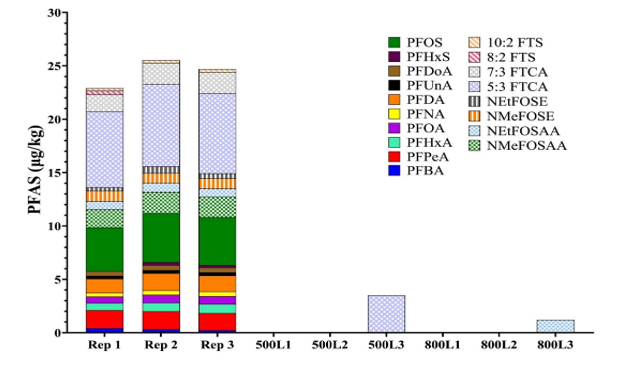
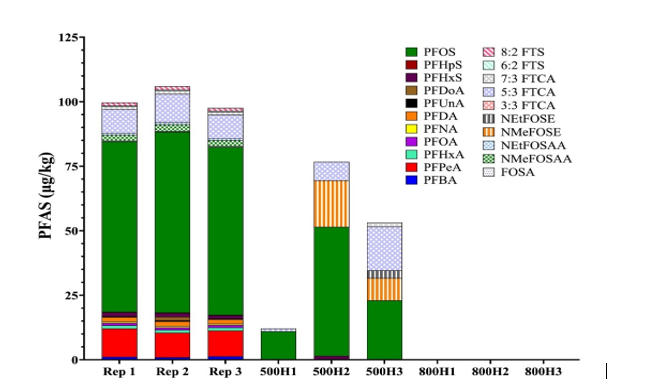
Recent research into the concentration of these forever chemicals within our biosolids has found that high temperature pyrolysis is the solution to their destruction (e.g., Buss 2021, Sarvi et al. 2023, Sørmo et al. 2023, Thoma et al. 2022). Moreover, the biochar output can then be used within a number of industries such as a soil amendment, activated carbon and construction materials. McNamara et al. (2026) found PFAS removal greater than 95% within biosolids with an initial low PFAS concentration with pyrolysis at 500°, and over 95% removal within biosolids with a high PFAS concentration with pyrolysis of 800° (Figure 1). This further highlights the applicability of high temperature pyrolysis for the best biochar output. The PFAS compound PFOS was still found within biochar produced from 500°, however this was destroyed within the 800° process. This study also analysed the py-liquid and py-gas and found that these outputs of the pyrolysis held some of the PFAS not destroyed in the process. These outputs can be further conditioned and mitigated to remove PFAS if needed through a thermal oxidizer process (Sheilds et al. 2025).
Other research further indicates the need for high temperature pyrolysis to remove PFAS within biosolids, with most existing in the gas phase following 500 and 700° pyrolysis (Bamdad et al. 2022), and papers suggesting a secondary higher temperature phase to remove persistent compounds (e.g., Schlederer et al. 2024).
Not only is the biochar produced PFAS free, research indicated an increase in surface area and pore structure through the use of biosolids as a feedstock, as well as metal stabilizing properties, especially at higher pyrolysis temperatures (Vali et al. 2025). This is highly beneficial for environmental applications such as soil conditioners. It was found that despite the pyrolysis process destroying the PFAS compounds, inorganic compounds such as some heavy metals (e.g., cadmium, nickel and chromium), surpassed agricultural guidelines when pyrolysis temperatures were low (350°) (Schlederer et al. 2024) and therefore should be controlled and analysed fully before use as a soil supplement. In the UK, application as a soil amendment could prove difficult. In most circumstances, sewage derived biochar remains a waste material unless an End-of-Waste route can be demonstrated. Consequently, routine use as an agricultural soil amendment is currently far more constrained than biochar produced from clean biomass feedstocks. Alternatively, sewage derived biochar could still be used within construction materials and potentially for biogas optimization in anaerobic digestion plants.
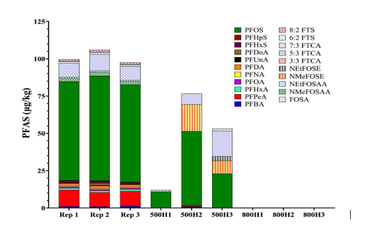
Figure 1 (taken from McNamara et al. 2026): Concentrations of PFAS from biosolids before (Rep 1,2,3) pyrolysis and after at both 500° and 800° temperatures. 3 samples were taken for each test to ensure precise and repeatable results. L correlates to biosolid samples with a low PFAS background. H correlates to biosolids samples with high background PFAS levels due to industrial impact.
References:
Bamdad, H. et al. (2022) ‘High-temperature pyrolysis for elimination of per- and polyfluoroalkyl substances (PFAS) from Biosolids’, Processes, 10(11), p. 2187. doi:10.3390/pr10112187.
Buss, W. (2021) ‘Pyrolysis solves the issue of organic contaminants in sewage sludge while retaining carbon—making the case for sewage sludge treatment via pyrolysis’, ACS Sustainable Chemistry & Engineering, 9(30), pp. 10048–10053. doi:10.1021/acssuschemeng.1c03651.
McNamara, P.J. et al. (2026) ‘Pfas removal during pyrolysis of biosolids is affected by initial pfas concentration and pyrolysis efficiency’, Water Environment Research, 98(4). doi:10.1002/wer.70352.
Perfluoroalkyl and Polyfluoroalkyl Substances (PFAS) (no date) National Institute of Environmental Health Sciences. Available at: https://www.niehs.nih.gov/health/topics/agents/pfc (Accessed: 22 May 2026).
Sarvi, M. et al. (2023) ‘Industrial pilot scale slow pyrolysis reduces the content of organic contaminants in sewage sludge’, Waste Management, 171, pp. 95–104. doi:10.1016/j.wasman.2023.08.018.
Schlederer, F., Martín-Hernández, E. and Vaneeckhaute, C. (2024) ‘On safety of sewage biosolids valorisation: Distribution of pfas, pahs, PCDD/Fs, and heavy metals in low-temperature pyrolysis end-products for agricultural and energetic applications’, Chemical Engineering Journal, 498, p. 155534. doi:10.1016/j.cej.2024.155534.
Shields, E.P. et al. (2025) ‘The use of air pollution controls to reduce the gas-phase emissions of per- and polyfluoroalkyl substances from a fluoropolymer manufacturing facility’, Environmental Science & Technology Letters, 12(6), pp. 768–773. doi:10.1021/acs.estlett.5c00402.
Sørmo, E. et al. (2023) ‘The decomposition and emission factors of a wide range of pfas in diverse, contaminated organic waste fractions undergoing dry pyrolysis’, Journal of Hazardous Materials, 454, p. 131447. doi:10.1016/j.jhazmat.2023.131447.
Thoma, E.D. et al. (2022) ‘Pyrolysis processing of pfas-impacted biosolids, a pilot study’, Journal of the Air & Waste Management Association, 72(4), pp. 309–318. doi:10.1080/10962247.2021.2009935.
Vali, N. et al. (2025) ‘Copyrolysis of municipal sewage sludge with agricultural residues: A theoretical and experimental study for tailored biochar production’, ACS Omega, 10(21), pp. 21308–21323. doi:10.1021/acsomega.4c11089.
Klere Limited
Nature data and carbon capture.
enquiries@klere.uk
Tel: 0203 583 1263
© 2024. All rights reserved.